
The short answer
Most outdoor weddings need a power source rated between 3,000 and 7,000 watts. String lights and a DJ need about 1,500W of capacity. Add a live band and you're near 3,500W. A caterer with warming equipment can push past 5,000W on its own.
Those are rated figures — the ceiling to plan for with everything switched on. What the equipment actually draws hour to hour is a good deal lower, and that working draw is what decides how many batteries a day needs. Both numbers are in the table below.
Wedding equipment — watts to plan for
| Equipment | Rated — plan capacity for | Typical working draw |
|---|---|---|
| String lights (100 ft LED) | 60–100W | 60–100W |
| DJ setup (controller + 2 powered speakers) | 800–1,500W | 300–500W |
| Live band PA with a subwoofer | 2,000–3,500W | 600–900W |
| Uplighting (12 fixtures) | 120–360W | 50–150W |
| Catering warming trays (each) | 800–1,200W | 800–1,200W, for as long as they're on |
| Commercial coffee urn | 1,000–1,500W | The same, but only while it's heating |
| Bar blender / ice machine | 500–1,500W | Blender: seconds at a time. Ice machine: cycling all day |
| Photo booth | 500–800W | 300–500W |
Add up the rated column for the items you actually have — that's the capacity to plan for. Two things to know while you count:
- Sustained heat is what costs you, not brief heat. A coffee urn or a kettle draws hard but only while it's heating — over a whole day that's a rounding error. Warming trays, fryers and flat-tops that hold temperature for hours are the ones that add up.
- Electronics and LED lighting barely register. Sound systems, laptops, POS terminals, phone charging and modern LED string lights are the light end of the list.
How our units compare
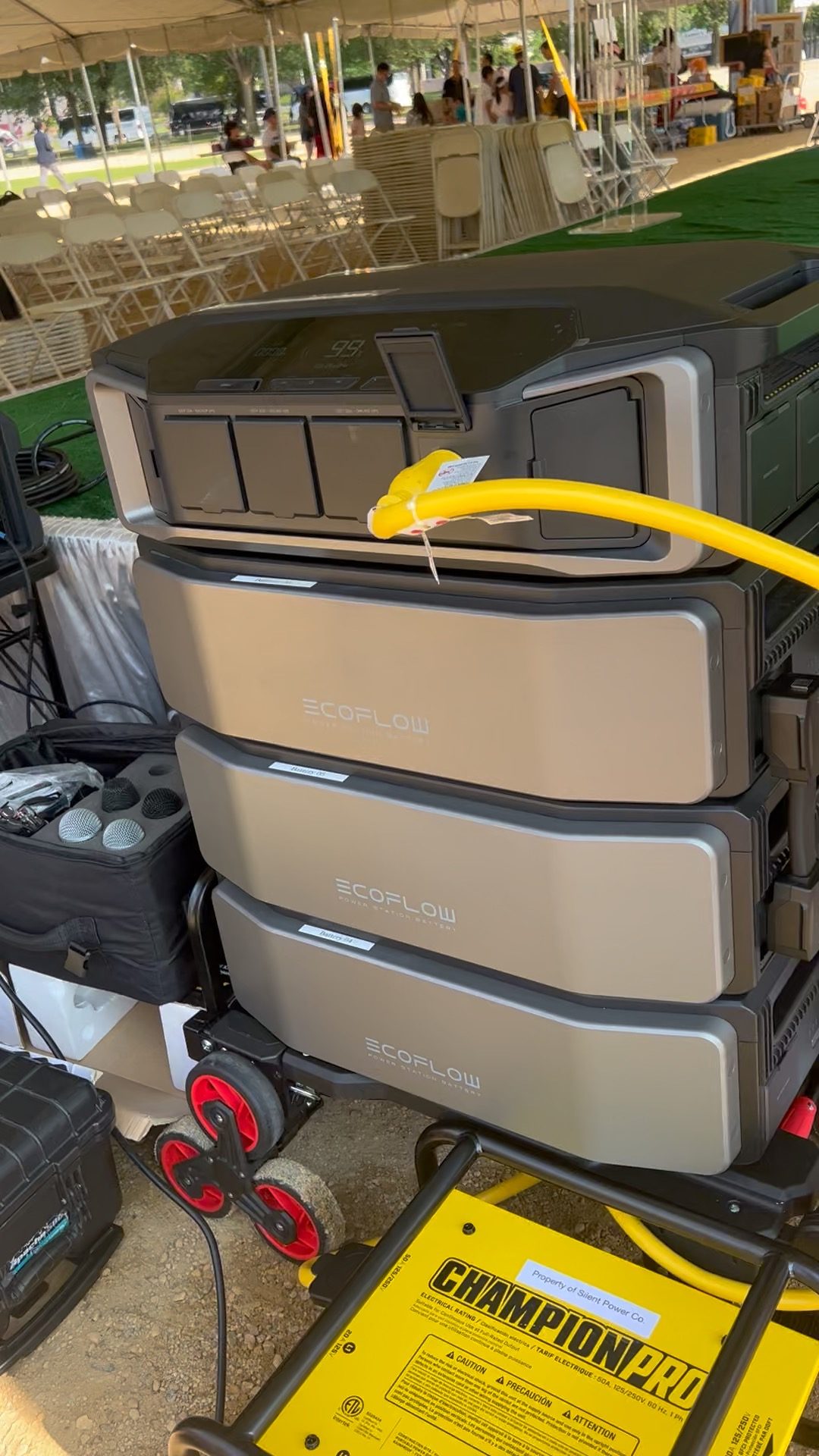
One of our units runs 7,200W continuous, 10,800W surge — enough for most weddings on its own. How many batteries a day needs comes down to what's plugged in and for how long, and that's what we size with you before the date.
You don't need to calculate any of this yourself. Tell us what you're plugging in and how long the event runs and we'll size it. If you're borderline, we'll say so.
Rough guide to configuration
| Situation | Typical package |
|---|---|
| Backyard party — inflatable, speaker, lights | Small Event — Full Event if it runs long |
| Small ceremony — mics, speaker, light catering | Small Event |
| Vendor row / farmers market — several booths | Full Event |
| Wedding — DJ or band, lighting, bar, catering, full day | Large Event |
| Live band with full PA + stage lighting | Large Event |
| Festival stage, long day | Large Event |
These are starting points, not promises. The variables that change everything: how many hours, and whether anything stays hot or cold for hours.
What draws the most (and what barely registers)
Heat is the enemy of runtime. Anything that converts electricity into heat is a heavy draw: commercial fryers, large flat-tops, full convection ovens, big resistive heaters. These are what push a setup up a package — or beyond what battery makes sense for.
Motors are moderate but constant. Refrigeration compressors, ice makers, and inflatable blowers don't spike hard, but they run continuously, which adds up across a long day.
Electronics and LED lighting are the light end. They're the easy part of the list — sustained heating and cooling are where the numbers move.
Where we're not the right answer: heavy continuous industrial loads, large commercial kitchen heating equipment, or big construction draw. We'll tell you honestly if that's your situation rather than sell you something that won't hold up.
The distribution box is included
Every rental comes with a pro-grade power distribution box — multiple independent 20-amp outlets with both 120V and 240V drops. Your vendors plug into that, not into the battery.
No daisy-chained power strips, no adapter stacks, no one circuit carrying everything. We bring the cords too.
Questions
How do I know what I need?
Send an inquiry describing what you're plugging in and how many hours. We'll recommend a configuration. If you're borderline, we'll say so.
What if we underestimate on the day?
That's exactly why we ask about your load in advance and build in headroom. Tell us if you think you'll add vendors or equipment.
Can several vendors share one unit?
Yes — that's what the distribution box is for. How many depends on what each is drawing.
Can it run all day?
Runtime is a function of draw. Long days are a batteries question, and we size for it. Give us your hours.
Do you deliver and set it up?
Yes — always. Delivery, setup and pickup are included within 20 miles of Chevy Chase, DC. You never haul or fuel anything.