
The short answer
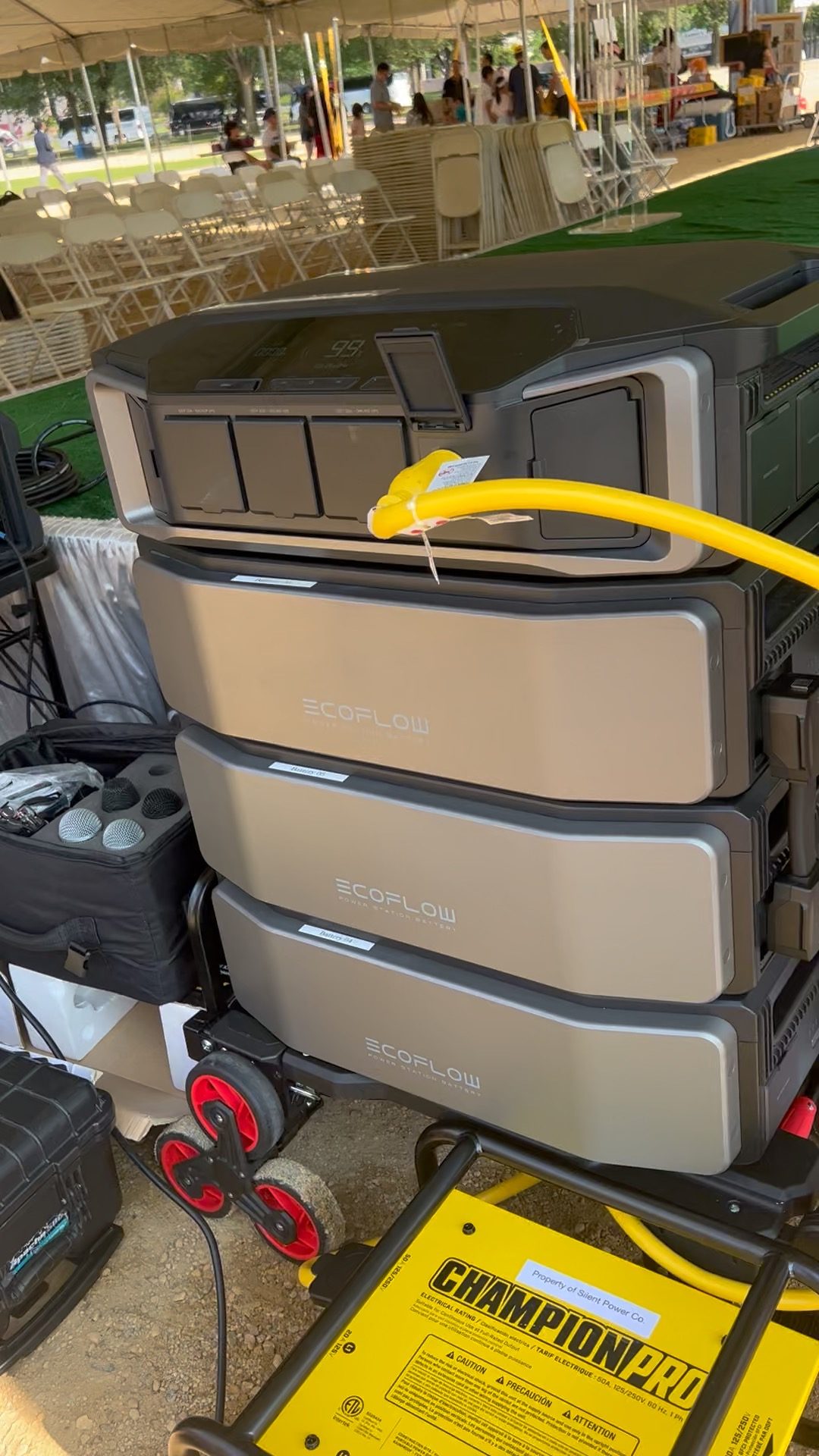
Under 30 dB, per the manufacturer's specification for the units we rent.
A typical portable gas generator runs 60–75 dB.
That gap is far larger than the numbers suggest, and the reason is worth understanding before you plan an event around one.
Decibels don't work the way people assume
Decibels are logarithmic, not linear. The rule of thumb used across acoustics: every 10 dB increase is perceived as roughly twice as loud.
So a 65 dB generator isn't "a bit noisier" than a 30 dB one. Work through the perceived doublings and it's in a completely different category — the difference between equipment you have to raise your voice over and equipment you forget is running.
For reference points people actually recognize:
| Sound | Approx. level |
|---|---|
| Quiet library / soft rustling | ~30 dB |
| Battery generator (our units, rated) | under 30 dB |
| Normal conversation | ~60 dB |
| Typical portable gas generator | 60–75 dB |
| Busy street | ~70–80 dB |
A gas generator at your event is, roughly speaking, a busy street running continuously for the duration.
Why it isn't just the volume — it's the kind of noise
Two sounds at the same level don't bother people equally. Generator noise is particularly intrusive because it is:
- Constant. It never stops for the length of your event, so it never fades into the background the way variable noise does.
- Low-frequency. Engine drone travels, carries around corners and through tent walls, and is very hard to acoustically screen.
- Mechanical. Human hearing is unusually good at picking mechanical sound out of natural ambience — which is exactly why it's so noticeable in a garden, a park, or during a ceremony.
This is why "just put it farther away" only half works. Distance reduces level, but drone still carries — and at most event venues you don't have anywhere far enough to put it.
Where the difference decides the event
Weddings. Vows, readings, and toasts are quiet moments with open microphones. An engine underneath them is on every video, forever.
Live music and DJs. Generator drone bleeds into open mics and sits under the mix. Sound engineers notice immediately.
Parks, the National Mall, and protected areas. Many permits carry explicit sound conditions. Under 30 dB generally clears them; 60–75 dB frequently does not.
Backyard parties in close-set neighborhoods. A gas generator running all afternoon is what generates neighbor complaints.
Film and photo. Continuous drone ruins location audio, full stop.
Anywhere ambiance is the point. If people chose the venue because it's beautiful and peaceful, an engine undoes the reason they chose it.
Why ours is silent — mechanically
There's no mystery to it. A gas generator makes noise because it's an internal combustion engine: pistons, exhaust, cooling fan, vibration through the frame.
A battery generator has no engine at all. It stores energy and inverts it to AC. The only moving parts are cooling fans, which run intermittently and gently. Nothing combusts, nothing reciprocates, nothing vibrates.
That's also why the other advantages come along for free: no exhaust, no fuel smell, no carbon monoxide, and no refueling.
Common questions
Is "under 30 dB" measured at the unit or at a distance?
Manufacturer rating is measured close to the unit, at roughly 0.5 m under a typical load. At normal event distances it's effectively inaudible against ambient noise.
Does it get louder under heavy load?
Cooling fans work harder under sustained heavy draw, so it isn't literally zero. But there's still no engine — it stays in a completely different range from combustion equipment.
Will guests standing next to it hear anything?
Little to nothing in a normal event environment. People are routinely surprised it's running.
How does this compare to an "inverter" gas generator?
Quiet gas inverter models are better than standard ones, but they're still combustion engines, typically in the 50–60 dB range — and they still produce exhaust and carbon monoxide. Battery removes noise and emissions.
Is quiet the only advantage?
No. For many clients the deciding factor is safety and logistics: no carbon monoxide (so it can run under a tent or indoors), no fuel to store or spill, and no refueling — plus we deliver and set it up.