Built for the way festivals actually work
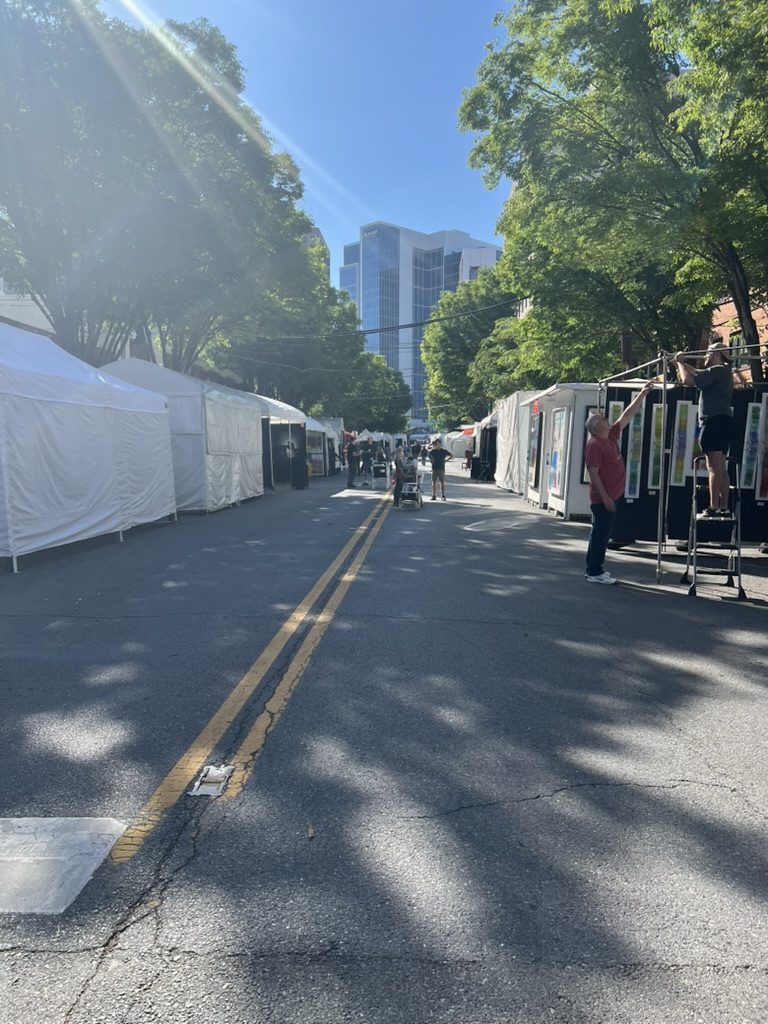
We've powered art fairs, vendor rows and multi-day public festivals — including a three-day permitted public festival on the National Mall.
What that looks like on the ground:
- One drop, many vendors. We deploy a pro-grade power distribution box with multiple independent 20-amp outlets, so several booths plug into a single source. No daisy-chained strips, no adapters.
- Set up before the street opens. We stage the unit early, position it out of the pedestrian path, and it's running before your first vendor arrives.
- Nothing to manage during the day. No refueling, no monitoring, no engine to restart.
- Silent teardown. We come back and roll it out.
Scale it to the event
- A block party or small vendor row — the Small Event package: a single inverter and battery covers lights, a speaker system, POS terminals, and light vendor loads.
- A mid-size festival — the Full Event package: a second battery for a longer day and a heavier mixed load.
- A large festival with a real stage — the Large Event package: one inverter with four batteries, for stage sound and lighting through a long day.
We're a fit from a neighborhood block party up through large festivals and sizeable stages. We're not the right call for a 50,000-person stadium concert or heavy industrial power — we're built for the community and mid-to-large event range, and we'll tell you honestly if your load is outside what we can cover.
What it powers along the row
- Stage sound: PA, monitors, mixing console, backline
- DJ rigs and microphone systems for announcements
- Stage and pathway lighting, string lights, uplighting
- Vendor booths: POS terminals, card readers, scales, label printers
- Food vendors: espresso and coffee carts, plus warming trays and refrigeration once we've sized for them
- Fans, phone charging, info-booth equipment
→ Full detail: What a battery generator can power
Why organizers pick battery for a public street
Noise. A gas generator runs 60–75 dB, all day, on a street where people are meant to linger, talk, and listen to music. Our units are rated under 30 dB. That's not a marginal improvement — decibels are logarithmic, so a 10 dB difference is perceived as about twice the loudness.
Fumes near food. Exhaust drifting through a row of food vendors is an obvious problem, and it's one you simply don't have with battery.
Permits. Many street-closure and public-event permits carry sound conditions and restrictions on fuel storage. Battery makes compliance straightforward. Send us your permit conditions and we'll confirm against them.
Safety. No carbon monoxide means it can sit under a tent or canopy where a combustion generator genuinely shouldn't.
And you're not hauling anything
No Home Depot run, no 200-pound generator in somebody's truck, no gas cans stored on a closed street, no mid-festival refueling. We deliver on a cart, place it, plug in the distribution box, and collect it afterward. Delivery, setup and pickup included within 20 miles of Chevy Chase, DC.
We bring the distribution box and cords. Have a covered spot for it — out of direct sun and rain.
Festival questions
Can several vendors share one unit?
Yes — that's the normal setup. The distribution box has multiple independent 20-amp outlets. How many booths depends on what each is drawing; tell us the mix and we'll size it.
How long will it run?
Depends on the load. For long festival days we add batteries. Give us your hours and equipment and we'll spec it.
Can it handle a stage and a band?
Yes — see our page on band and stage power. A full band PA with stage lighting is what the Large Event package is built for.
Do you set up before the event opens?
Yes. We stage early so everything is live before vendors and the public arrive.
What if the festival runs multiple days?
We've powered a three-day permitted public festival on the National Mall — multi-day is something we plan for. We'll build the configuration and service plan around your schedule.