
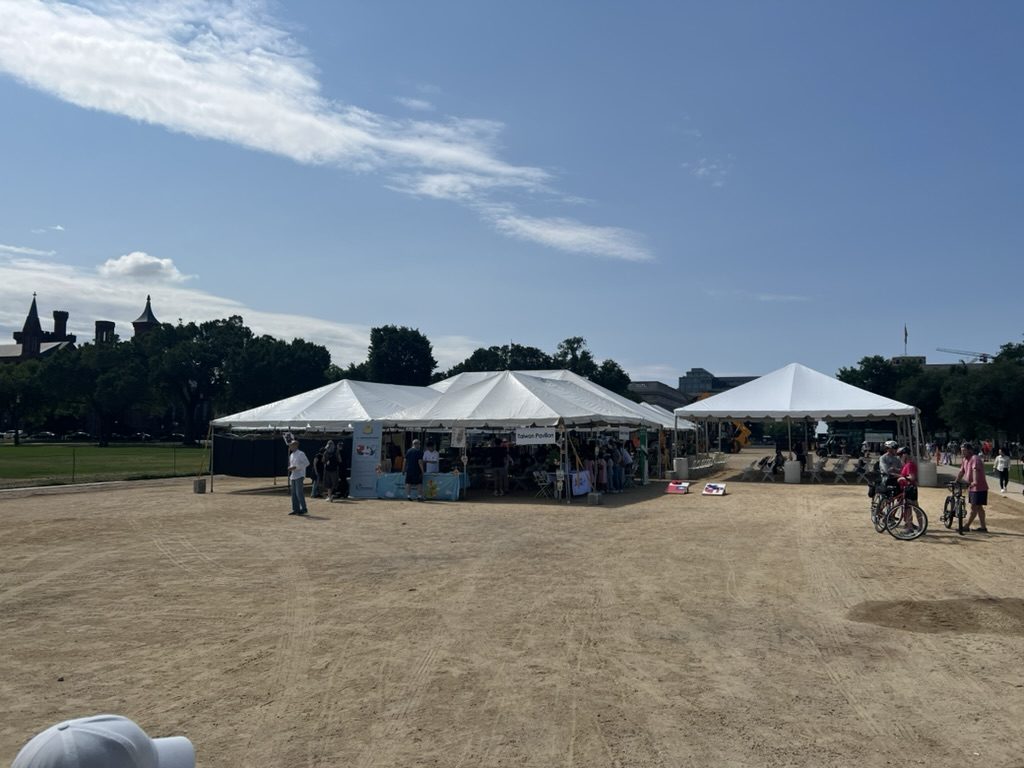
Which venues typically have no power
The DMV has a lot of beautiful wedding venues that were never wired for events. If yours is one of these, plan to bring the power source:
- Working farms and vineyards in Loudoun County (Leesburg, Middleburg, Purcellville) — often just a barn with one 20-amp outlet
- Fields and estates in Maryland's Montgomery, Howard, and Frederick counties — beautiful, unpowered
- National Park Service land — Rock Creek Park, the National Mall, C&O Canal sites — no outlets, and fuel-burning generators are restricted or prohibited
- Historic properties where you can't run new electrical wiring
- Botanical gardens, nature centers, and preserves that permit events but weren't built as event venues
- Private residences where the outdoor outlet is 300 feet from where you're actually holding the ceremony
What to ask your venue before you book
Even venues that host weddings regularly are inconsistent about this. Ask:
- Is there any outdoor power source? If yes: how many amps, what type of outlet, and where exactly?
- How far is that source from the ceremony site? From the reception site? From where the caterer will set up?
- Are gas generators permitted? Any noise ordinance? Any fuel-storage restriction?
- Has a previous wedding done house power alone, or does everyone rent a generator?
The last question is the most useful. If every past event brought a generator, that's your answer.
How much power you need
Most outdoor weddings need a power source rated for 3,000–7,000 watts once you count lighting, a DJ or band, and catering equipment. Warmers are the biggest single-item load — each one is 800–1,200W, for as long as it's on.
→ Full load table: What size generator do I need for a wedding
Where to put it — and why battery changes this
With a gas generator, placement is a constant tradeoff between noise, exhaust, and getting power cable to where the vendors are. Rule of thumb: 30+ feet from any tent opening, exhaust pointed away, and cable runs kept under 100 feet to avoid voltage drop. That's hard on a remote site where the caterer, the DJ, and the ceremony are in three different spots.
Battery removes the distance-and-noise tradeoff entirely. No exhaust to point away from anyone. No decibels to distance. It sits under a tent, behind a fence, beside the catering prep — wherever's convenient, plugged in, silent.
Permits and restrictions to know about
National Park Service land. Fuel-burning generators are restricted or outright prohibited on most NPS sites — including the National Mall, Rock Creek Park, and C&O Canal. Battery is often the only permissible option.
→ More on NPS-friendly power: National Mall & park event power
Local noise ordinances. Many jurisdictions have decibel limits for outdoor events. Battery at under 30 dB generally complies without discussion. Gas at 60–75 dB frequently doesn't.
Historic and protected properties. Fuel storage, exhaust drift, and vibration are all reasons some historic venues restrict combustion equipment on their grounds.
What it costs
Gas generator rentals run roughly $80–$200/day at a Home Depot or a rental yard, plus fuel, your time to move a 200-lb machine, and someone to refuel it during the event.
Silent Power battery rentals start at $180/day, delivered. Includes delivery, setup, a pro-grade power distribution box, and same-day pickup within 20 miles of Chevy Chase. You never touch the equipment.
→ Detailed cost breakdown: How much does it cost to rent a generator for a wedding
Questions from remote-venue weddings
Our venue is on a working farm with almost no infrastructure — is that a problem?
No, that's exactly what we're built for. The unit arrives fully charged and self-contained. Nothing to plug in on the venue's side.
Do you deliver to Loudoun County?
Yes. Loudoun (Leesburg, Middleburg, Purcellville) is one of the areas we go to most for weddings, because so many of the region's best venues sit on beautiful property with almost no electrical infrastructure. Delivery is included within 20 miles of Chevy Chase. From 20 to 80 miles is +$100; past 80 miles we quote individually.
Our venue is in a park. Can we use a gas generator there?
Depends on the park. Many national and county parks restrict or prohibit combustion generators due to noise ordinances, air-quality rules, or fire-safety concerns. Send us the venue and we'll check.
What if the venue has one outlet but it's 200 feet away?
Long runs cause voltage drop — equipment gets fewer volts than it needs, which can damage motors and audio equipment. If the outlet is 100+ feet from where you actually need power, rent a source that goes where the load is.
Can the unit run inside or under a tent?
Yes — that's a core advantage of battery over gas. No combustion means no carbon monoxide, so it's safe to place inside or under any covered space. It just needs to stay out of direct sun and rain.