
Why couples rent battery instead of gas
If you have stood near a portable gas generator at an outdoor event, you already know the problem. It drones. The whole time. Through the readings, through the toasts, underneath the first dance. Your photographer will never capture it — but every guest hears it, and your officiant has to talk over it.
There's a measurable difference, not just a vibe:
- A typical portable gas generator runs about 60–75 dB.
- Our battery units are manufacturer-rated at under 30 dB.
Decibels are logarithmic, so that gap is bigger than the numbers look — a 10 dB increase is perceived as roughly twice as loud. A gas generator isn't slightly noisier than what we bring. It is in an entirely different category of sound.
And then there's what you don't smell. No exhaust drifting across the dance floor. No fuel odor near the bar. No carbon monoxide risk, which is what makes battery power usable under and beside tents where a gas unit genuinely should not run.
What it powers at a wedding
- Ceremony microphones, a speaker, and music playback
- DJ setup — controller, mixer, powered speakers, subwoofer
- A live band's PA, monitors, and backline
- String lights, bistro lighting, and uplighting
- Photo and video continuous lighting, plus camera battery charging
- Espresso cart or coffee service
- Bar: blender, plus a fridge or ice maker once we've sized for it
- Caterer's warming trays and chafing setup — tell us how many, because they run for hours
Not sure which package fits? That's what the quote conversation is for — tell us what you're plugging in and we'll tell you straight.
→ See the full breakdown: What a battery generator can actually power
You don't have to touch any of it
This is the part couples underestimate. The alternative to renting from us isn't "a quieter generator" — it's you driving to Home Depot the week of your wedding, wrestling a 200-pound generator into a vehicle, getting it to the venue, finding gas cans, and then having somebody refuel it partway through your reception.
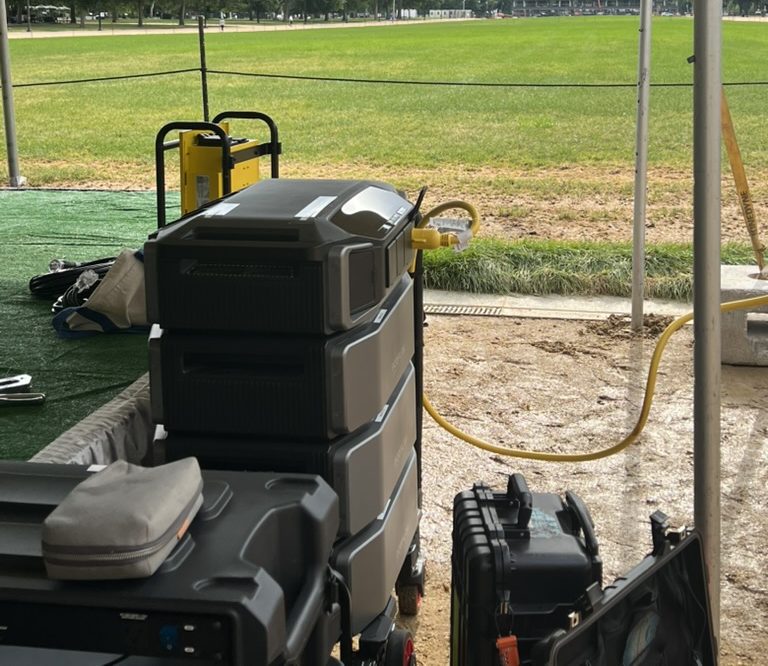
We deliver it on a wheeled cart, position it where you want it — behind a tent panel, against a fence line, tucked in a garage — plug in your vendors, and come back for it when you're gone. Delivery, setup, and pickup are included within 20 miles of Chevy Chase, DC.
One logistics note we tell every client: the unit needs to stay out of direct sun and rain, so plan a spot for it under a tent or other cover. We bring the power distribution box and cords.
Where we deliver — by state
Delivery is included within 20 miles of Chevy Chase, DC, which covers most of the DMV wedding corridor. From 20 to 80 miles is +$100; past 80 miles we quote individually.
Northern Virginia
Loudoun County (Leesburg, Middleburg, Purcellville) — this is where the region's wine-country and farm-venue weddings live, and most of them are on beautiful private property with almost no electrical infrastructure. Also Fairfax County (Vienna, Reston, Herndon), Arlington, Alexandria, McLean, Great Falls, Falls Church.
Maryland
Montgomery County (Bethesda, Chevy Chase MD, Potomac, Silver Spring, Rockville, Takoma Park, Kensington), Howard County (Columbia, Ellicott City), Frederick County, and out to Anne Arundel (Annapolis). Same story as the Virginia side: beautiful outdoor venues, almost no outlets.
Washington DC
Any private residence, garden, historic property, or rented estate inside the District — plus permitted outdoor and park venues where a fuel-burning generator would be prohibited, unsafe, or ruin the ambiance.
Private homes, rented estates, gardens, barns, vineyards, historic properties: if it's within reach of DC and it doesn't have the power you need, that's the situation we're built for.
Wedding power questions
Will we actually hear it during the ceremony?
No. There's no engine and no combustion — nothing that idles, revs, or vibrates. It's rated under 30 dB. You can stand beside it during the vows.
Can it be hidden from guests?
Yes. It's roughly the footprint of a small mini fridge on a cart. We routinely place it behind a tent panel, along a fence, or inside a garage. It doesn't turn up in photographs.
What if our venue has no power at all?
That's the normal case for us. The unit arrives fully charged and self-contained. Nothing to plug into, no hookups needed, no fuel.
Our caterer needs real power. Is that a problem?
Usually not, but tell us early. Coffee service is easy. Warming trays, fridges and ice machines run for hours, so they're what we size around — send us your caterer's equipment list and we'll work it out properly.
How far in advance should we book?
Friday and Saturday dates from May through October go first. Reserve as early as you can. Last-minute inquiries are still worth sending — we sometimes have availability.
What about rain?
The unit needs to stay covered and out of direct sun and rain, so we'll ask you to plan a sheltered spot for it — under a tent, an awning, or similar. We'll walk through placement with you beforehand.