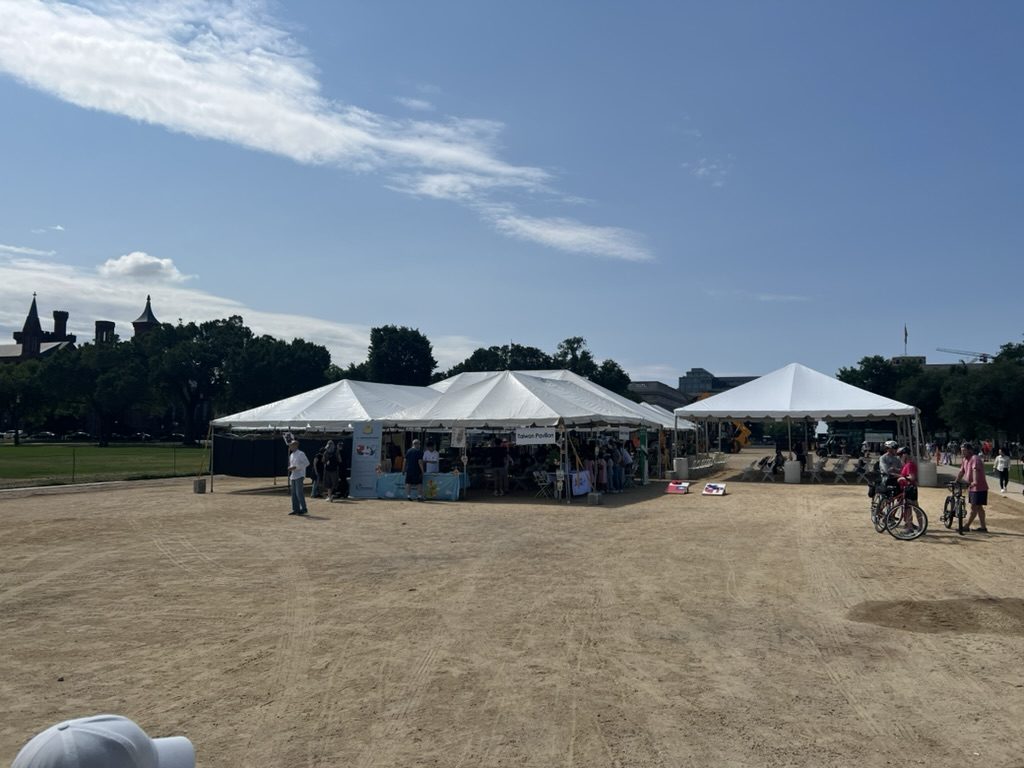
We've done this on the Mall
We've powered a three-day permitted public festival on the National Mall — in one of the most sensitive and heavily regulated venues in the country.
We know what that setup involves: staging equipment in before the public arrives, keeping the footprint discreet, keeping it silent, and leaving no fuel, no fumes, and no trace behind.
Why battery is often the only option in protected spaces
Parks, historic sites, and protected areas restrict combustion equipment for reasons that are easy to understand once you've been on site:
- Emissions and fuel handling. No gasoline transported or stored on protected ground. No spill risk near soil, water, or root systems.
- Noise ordinances and permit conditions. Many permits explicitly limit sound. A 60–75 dB gas generator can put you out of compliance; a unit rated under 30 dB generally doesn't.
- Carbon monoxide. Under tents, in pavilions, in any covered or partially enclosed area, a combustion generator is a real safety hazard. Battery has no exhaust at all.
- Wildlife and visitor experience. The whole reason people hold events in these places is the setting. An engine droning through it defeats the purpose.
A battery unit sidesteps all of it. There's nothing to burn, nothing to spill, nothing to hear.
What this covers
- Festivals and public events on the National Mall and other NPS ground
- Park events — Rock Creek, county and regional parks across MD and NoVA
- Forest and rural venues where the nearest outlet is a quarter mile away
- Historic properties where you can't run new electrical
- Botanical gardens, nature centers, preserves
- Trailhead and waterfront events along the C&O Canal and Potomac
- Vendor rows, stages, A/V, lighting, and food service in any of the above
We carry it in — you don't
Getting power into a park is the hard part, and it's the part we take off your plate entirely.
There's no trip to Home Depot, no 200-pound generator to lift into a truck, no gas cans riding along, no refueling run in the middle of your event. We bring it on a wheeled cart, position it exactly where you want it, plug in your vendors, and return for it afterward. Delivery, setup and pickup are included within 20 miles of Chevy Chase, DC.
We bring the power distribution box and cords. One thing we'll ask of you: a spot under a tent or cover, out of direct sun and rain.
Scaling up
A single inverter and battery handles a small ceremony, a speaker system, or a short vendor row. A longer day or a bigger row is the Full Event package. For a full stage with sound and lighting at a large public festival, that's the Large Event package: one inverter with four batteries, for the energy to run a full day.
→ See what that actually runs: What a battery generator can power
Questions about park and Mall events
Do you have experience with permitted public events?
Yes — we've powered a three-day permitted public festival on the National Mall.
Our permit limits generator noise. Does this comply?
Our units are manufacturer-rated under 30 dB, versus roughly 60–75 dB for a typical portable gas generator. Send us your permit's specific sound condition and we'll confirm against it before you book.
There is genuinely no power anywhere near our site. Is that a problem?
No — that's the standard case for us. The unit arrives fully charged and completely self-contained.
Can it run under a tent or in a pavilion?
Yes. With no combustion there's no carbon monoxide, which is exactly why battery works in covered spaces where gas generators shouldn't be used at all. It does need to stay out of direct sun and rain, so a covered spot is ideal.
How far out will you deliver?
Delivery is included within 20 miles of Chevy Chase, DC, covering most of the DMV. From 20 to 80 miles is +$100. Past 80 miles we quote individually.
How long will it run?
Depends entirely on the load. Tell us what you're powering and for how many hours, and we'll size the configuration.