
Your three options
For a tent wedding, one of these will be your answer. All three are legitimate in the right situation — including the ones we don't rent.
Option 1 — Run cable from the house
Works if: the house or venue has an outdoor panel within about 100 feet of the tent and the total draw fits on a single 20- or 30-amp circuit (roughly under 2,400–3,600 watts).
Doesn't work if: your load includes catering warming equipment (each warmer is 800–1,200W), or the run is over ~100 feet (voltage drop), or the panel is already loaded with the house.
Watch for: tripped breakers halfway through the reception when someone plugs in a coffee urn. This is the single most common thing that goes wrong at a house-tent wedding.
Option 2 — Rent a gas generator
Works if: you have somewhere far enough from the ceremony and reception to place it (usually 30+ feet), the venue permits fuel storage, and no one minds a low continuous drone through the vows.
Doesn't work if: the tent is in a park with generator restrictions, the venue is close-set with neighbors, or you want speeches and vows recorded cleanly.
The honest tradeoff: a typical portable gas generator runs 60–75 dB, which is louder than a normal conversation. Distance reduces the level but the low-frequency drone still carries. You'll also be arranging fuel storage and someone to refuel it partway through the day.
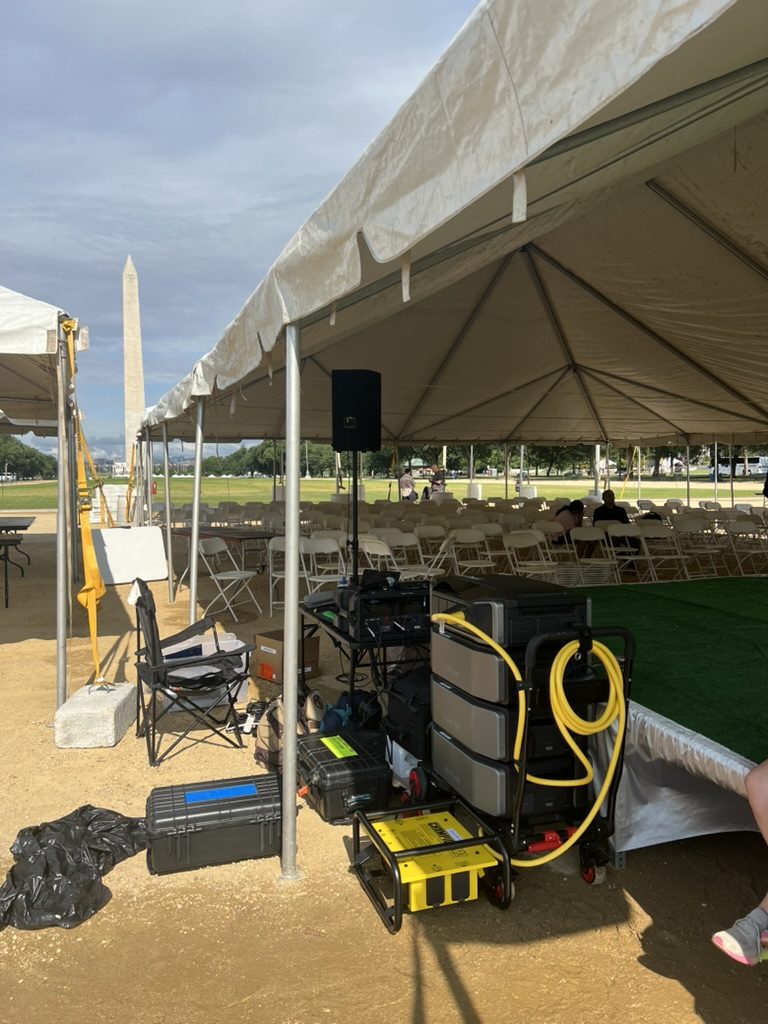
Option 3 — Rent a battery unit
Works if: you want the ceremony and reception to sound like they weren't run on a generator at all — no engine hum on the videographer's audio, no drone under speeches, no exhaust drifting under the tent.
What it is: a self-contained lithium unit that outputs standard 120V (and 240V when you need it) with no combustion. Manufacturer-rated under 30 dB. It sits under the tent or beside the caterer's prep area safely because there's no carbon monoxide.
Where it falls short: if your catering setup has heavy commercial fryers or all-day sustained heavy heating equipment, that's what pushes past what battery makes sense for. We'll tell you honestly.
How to work out your load
Add up the rated wattage of everything that will run at the same time. Rough numbers to plan for at a typical outdoor wedding:
- String lights (100 ft LED): 60–100W
- DJ setup (controller + 2 powered speakers): 800–1,500W
- Live band PA with a subwoofer: 2,000–3,500W
- Uplighting (12 fixtures): 120–360W
- Catering warming trays: 800–1,200W each
- Coffee urn: 1,000–1,500W
- Bar blender / ice machine: 500–1,500W
Most weddings land between 3,000W and 7,000W of rated load. What the equipment actually draws hour to hour is a good deal lower — a DJ setup rated at 1,500W typically works at 300–500W — and that working draw is what decides how many batteries the day needs.
→ Full load table + how to size: What size generator do I need for a wedding
Where to put the power source
Cable from the house: route it against the fence line or under a runner where guests won't trip. Test full load before the ceremony — an early trip is recoverable, one at 8 PM isn't.
Gas generator: at least 30 feet from any tent opening, exhaust pointed away from guests, and never inside a tent or garage (carbon monoxide is fatal indoors). Ceremony placement matters most — put it behind the reception if you have to choose.
Battery unit: anywhere convenient — behind a tent wall, in a garage, beside the catering tent. No exhaust means it's genuinely safe indoors and under cover. It does need to stay dry and out of direct sun, so plan a covered spot.
What it costs
Ballpark for the DMV, before delivery:
- Extension cable + power strips (you buy): $50–$150 for cable, strips, and a surge protector. Cheapest, but only viable if house power actually covers your load.
- Gas generator rental: roughly $80–$200/day at a Home Depot or a rental yard. Add fuel, your time to pick up and return, a vehicle capable of carrying a 200-pound machine, and someone to refuel it during the reception.
- Silent Power battery rental: from $180/day, delivered. Includes delivery, setup, a pro-grade power distribution box, and same-day pickup within 20 miles of Chevy Chase. You never touch the equipment.
→ Real numbers: How much does it cost to rent a generator for a wedding
Why silent matters specifically at a wedding
Every part of a wedding day has quiet moments with open microphones: the readings, the vows, the toasts, the first dance. Gas-generator drone shows up on every video from the day, sits under every recorded speech, and forces the officiant to project over it.
Battery removes it. Not "quieter" — categorically absent. Guests standing next to the unit routinely don't realize it's running.
Common questions
How do I know if the house has enough power to skip a generator?
Add up your total continuous load (including catering warmers, which are the biggest surprise). If it's under about 2,400W total AND the outdoor outlet is within 100 feet AND nothing heavy is running in the house, house power is worth trying. Anything else, rent.
Can a battery unit really run all day?
Yes, when it's sized for the day. Runtime depends on what your equipment actually draws hour by hour, not on its rated wattage. Each battery stores about 5.5 usable kWh and batteries stack — the Large Event package carries about 22. We size the setup to your event's hours and your equipment list, with reserve held back.
What if the caterer's setup is heat-heavy?
Heat is what pushes tent weddings past what a single small setup can handle. Multiple warming trays, hot boxes, and coffee equipment can easily total 4,000–5,000W just on the catering side. That's where more batteries or a hybrid setup comes in. Send your caterer's equipment list and we'll size it honestly.
Do gas generators really ruin ceremony audio?
Yes. Videographers universally hate them — the low-frequency drone bleeds into every open microphone and there is no fixing it in post. Battery is genuinely inaudible to a lavalier from a few feet away.
How far in advance should we book a rental?
Friday and Saturday dates from May through October go first. Book as early as you can. Short-notice inquiries are still worth sending — we sometimes have availability.