
The Short Version

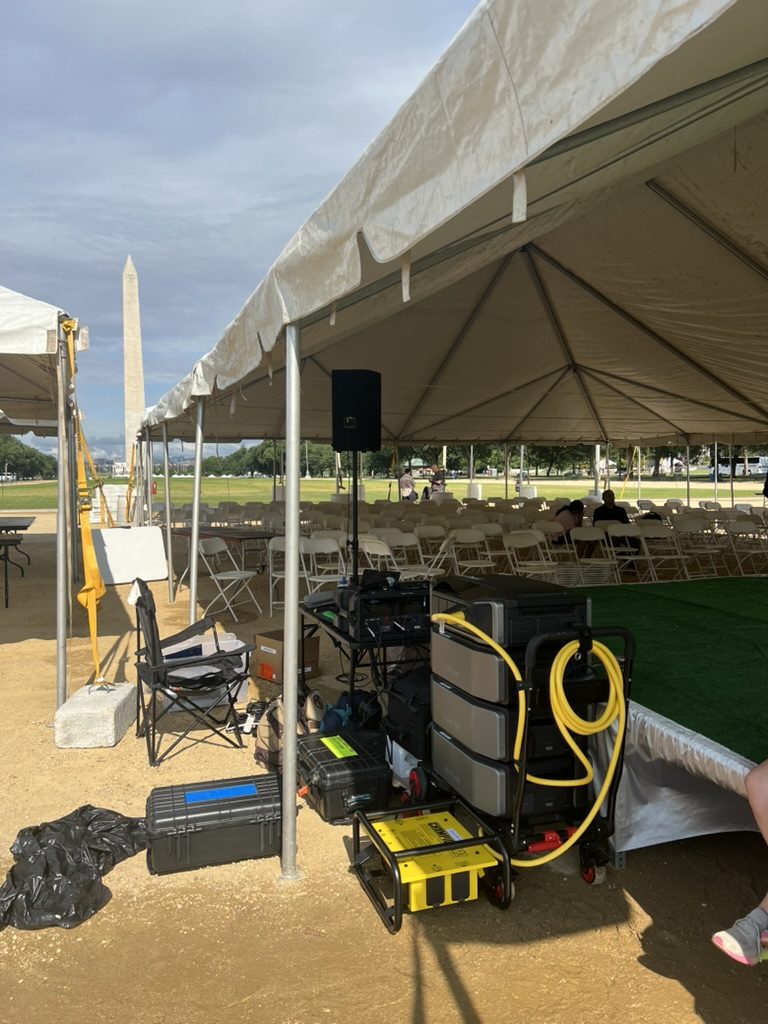
A paired silent battery generator setup (like our two-EcoFlow DELTA Pro Ultra fleet) delivers more continuous power than a popular 11,500-watt gas generator, runs in absolute silence, and produces zero exhaust. When you factor in the time, fuel, transport, and stress of renting and operating a gas generator yourself, the all-in cost is comparable to a delivered, set-up, and picked-up battery generator service. The battery option only loses on sustained high-load events lasting over eight hours.

Head-to-head: Our battery setup vs. a popular 11,500W gas generator

To make this concrete, we are comparing our two-EcoFlow DELTA Pro Ultra paired setup (with three batteries and a professional power distribution unit) against the Predator 11,500-watt Tri-Fuel Super Quiet Inverter Generator (Harbor Freight model 72614), which sells for around $2,100 and is one of the most popular gas generators rented from big-box hardware stores or purchased outright by event hosts.

Specification Our paired battery setup Predator 11,500W tri-fuel
Continuous power output 14,400 watts 9,000 W (gas) / 8,100 W (propane) / 7,200 W (natural gas)
Surge / starting watts 28,800 watts 11,500 watts
On-board energy storage 18.4 kWh stored None (depends on fuel)
Runtime at light load (~2 kW) ~9 hours 14+ hours on full gas tank
Runtime at medium load (~4 kW) ~4.5 hours ~7 hours on full gas tank
Noise level at gig volume 0 dBA (silent — no engine) 64.5–72 dBA (louder than conversation)
Carbon monoxide emissions Zero Yes (CO Secure auto-shutoff included)
Required clearance from guests Zero (sit it next to the DJ) 20+ feet, exhaust directed away
Can be used inside a tent or near a building opening? Yes No
Fuel handling required? No (recharged between events) Yes (gas, propane, or natural gas)
Pure sine wave output (safe for DJ gear, vintage amps)? Yes Yes
Unit weight ~120 lb per inverter + 50 lb per battery (modular) 259.5 lb single unit
Sticker / rental price $510 (Standard) or $820 (Premium) per day, delivered and set up $200/day rental, customer pickup

Two specs that often surprise customers: our continuous output (14,400 watts) is 60 percent higher than the Predator's continuous output on gasoline (9,000 watts), and our surge capacity (28,800 watts) is 2.5 times the Predator's surge rating (11,500 watts). The Predator's "11,500-watt" headline is the starting/surge rating — a momentary peak when an appliance turns on, not the sustained power available throughout the event. The continuous output is what actually runs your DJ, your lights, and your food prep all night.

The hidden cost of "just renting a gas generator"

Most customers do a quick mental comparison: $200/day from Home Depot is cheaper than a $510 delivered service. Done. But that comparison ignores the customer's actual time, effort, and risk. Here is the real all-in cost when you rent and operate a gas generator yourself for a typical outdoor event.

Line item Time / Cost
Daily rental fee (Home Depot, Sunbelt, etc.) $200
Damage protection / insurance waiver $25–60
Sales tax $15–25
Gasoline for a typical 5-hour event (~5 gallons) $20–30
Round-trip pickup drive (typically 45-90 min each way) 1.5–3 hours of customer time
Loading 260 lb unit (requires 2 people and a ramp or tailgate) 30 min + back risk + need to find a helper
Learning to operate the generator on event day 30–60 min of pre-event stress
Monitoring during the event (refueling, watching fuel level) 30 min spread throughout the event
Cleaning and returning on time (late return = extra day fee) 30 min + risk of late fee
Customer's labor time at $25–50/hour equivalent $100–250
True all-in customer cost $385–650 + 4–6 hours of stressful work

When the customer realizes their "$200 rental" actually costs them $400–600 in real money plus the better part of a workday in time and stress, the comparison to a $510 delivered, set-up, monitored, and picked-up battery service looks completely different. You are not paying more for the battery option. You are paying the same — for vastly better service and a better-sounding event.

Hypothetical scenario #1: A 100-guest Bethesda backyard wedding

The setup

Saturday, 4pm to 11pm — outdoor ceremony at 4:30pm, dinner under tent at 6, dancing 7:30 onward. 100 guests. The couple chose a backyard venue specifically for the intimate atmosphere.

Power needs:

  • DJ system (powered mains, sub, controller, laptop, lighting): ~2,000 W average
  • Officiant wireless microphone + small PA for ceremony: ~150 W
  • String lights and decorative uplighting: ~600 W
  • Coffee bar (espresso machine, hot water tower): ~1,500 W when running, used between dinner courses
  • Caterer warming trays: ~800 W
  • Photo booth (lighting + printer): ~400 W

Continuous load: ~3.5 kW typical, surging to ~5 kW during espresso bar peaks.

Total event duration with setup and breakdown: 8 hours customer-facing, 6 hours of active power use.

Option A: DIY Predator rental from Home Depot

  • $240 rental + insurance for the Predator 11,500W generator
  • Saturday morning: pickup drive to Bethesda Home Depot, 1 hour round trip with traffic
  • 30 minutes loading the 260 lb unit with a friend's help and a borrowed pickup truck
  • $25 of gas at the station on the way home
  • Place generator 20 feet from the ceremony arch and dinner tent (per CO safety), which puts it behind the garage
  • The 20-foot extension cords needed to reach the DJ, bar, and tent: borrow or buy ~$80 of heavy-gauge cords
  • During the ceremony: the generator hum is audible to guests in the back rows. The videographer mentions it later as the only audio note in their footage.
  • During first dance: the generator is louder than the slow song's quietest moment. Wedding video has a 64 dBA droning underneath every track.
  • 9pm: generator refueling stop interrupts the photo session for 15 minutes
  • 11pm: load 260 lb unit back into pickup truck after a long day
  • Sunday morning: return it to Home Depot before noon to avoid a late fee

Total cash: ~$345 + 5 hours of family time on Sat/Sun + audio compromise + back risk

Option B: Silent Power Co. Premium package, delivered

  • $820 Premium package for the paired setup (overkill for this load, but couple wanted full backup capacity)
  • Friday afternoon delivery — we drop the equipment, set it up, dial in the cable runs to the DJ, bar, and tent, and label every outlet
  • Saturday: completely zero customer involvement. The unit sits inside the wedding tent silently throughout the ceremony, dinner, and dance set
  • Ceremony audio is clean. Wedding video has only the music, vows, and laughter — no generator hum in the background
  • 11:30pm: we return for pickup. Guests are leaving. The couple is on a couch. We load and leave. They do not think about power once.
  • Sunday: nothing to do

Total cash: $820 + 0 hours of customer work + clean wedding video

The honest read: The DIY gas option saves the couple $475 in cash. It costs them 5 hours of pre- and post-event work, the integrity of their wedding video audio, and an interrupted photo session for refueling. For most couples spending $25,000+ on a wedding, the $475 they "saved" is a footnote they regret. For others, it is the right call. We tell every inquiry honestly which side of that line they are on.

Hypothetical scenario #2: A food truck at a corporate event

The setup

Tuesday afternoon corporate appreciation event at a Reston, VA office park. 3pm to 7pm. 200 employees. One food truck (soft-serve ice cream) plus a coffee bar plus a DJ for background music.

Power needs:

  • Soft-serve ice cream cart (compressor cycles): 1,800 W continuous, surging to 3,500 W on compressor starts
  • Espresso bar with hot water tower: 1,500 W intermittent
  • DJ for background music: 800 W
  • String lights for ambiance: 300 W
  • Cell phone charging station: 200 W

Continuous load: ~3 kW typical, surging to ~5.5 kW during ice cream compressor cycles + simultaneous espresso pull.

Total active power duration: 4 hours.

Option A: DIY gas generator

  • $200 rental + $40 insurance + $25 gas = $265 cash
  • Office park parking lot regulations require gas generators to be 20 feet from any building entrance and 20 feet from any food preparation area — meaning the generator goes in a far corner of the parking lot, requiring 75+ feet of heavy-gauge extension cable to reach the food truck and coffee bar
  • Gas exhaust drift is noticeable downwind of the ice cream cart, defeating part of the appeal
  • Employee Slack channel post-event: "the food truck was great but it was hard to talk to my colleagues over the generator hum"
  • HR contact tells the event company they want a quieter solution next quarter

Total: $265 + lost repeat business

Option B: Silent Power Co. Standard package

  • $510 Standard package, single inverter + battery configuration (handles the load with margin)
  • Battery sits beside the food truck — no clearance requirements, no exhaust, FDA-friendly placement
  • 15-foot cable runs to the espresso bar and DJ
  • Employees converse normally during the entire event. The food truck operator tips us at the end and asks for our card.
  • The HR coordinator asks for our contact info to book the same setup for the holiday party in December.

Total: $510 + first-quarter repeat booking secured

The honest read: For corporate event coordinators, the cost difference ($245) is negligible against their event budget — but the experience difference is enormous. This is exactly the kind of event we are built for, and where DIY gas options are penny-wise and pound-foolish.

When the silent battery generator wins (your ideal use case)

Our battery generator setup is the right answer when any of these are true:

1. Audio quality matters

Weddings, ceremonies, memorial services, outdoor speeches, podcasts, film shoots, photography sessions, intimate concerts. A gas engine at 64+ dBA bleeds into every microphone and every recording. Battery is silent. There is no second choice.

2. Event is under 6 hours of active power use

Most outdoor weddings, corporate events, birthday parties, food truck appearances, and brand activations fall in the 3-6 hour range. Our 18.4 kWh storage covers this comfortably, even at heavy loads.

3. Tight venues, tents, or buildings nearby

Backyards, urban townhouse gardens, rooftop decks, tented receptions, and any venue where a gas generator's 20-foot clearance requirement is impossible to meet. Battery sidesteps these constraints entirely.

4. Food prep or beverage service is part of the event

Food truck operators, caterers, ice cream carts, and espresso bars do not want gas exhaust next to their service area. Health departments and franchise contracts often require it. Battery is the only safe, code-compliant option in many cases.

5. The venue is in DC, on federal land, or in a place where gas generators are restricted

The National Mall, Rock Creek Park, Anacostia Park, Yards Park, and many DC neighborhood parks restrict or prohibit gas generators. The DC noise ordinance limits engine generator use after 10pm in residential areas. Battery generators bypass these restrictions.

6. The customer values their own time

Anyone earning more than $25/hour effectively saves money by paying for a delivered service over a DIY pickup. Anyone planning a meaningful event does not want to spend Saturday morning loading 260 pounds of metal into their car.

7. The event has aesthetic or brand standards

Brand activations, wedding ceremonies, premium corporate events, magazine photography, real estate open houses. A gas generator in the background of an Instagram video is a deal-breaker. Battery is invisible.

When the gas generator wins (being honest)

We are not the right choice for every event. Here is where a gas generator (rented or owned) is the better tool:

1. All-day high-load commercial events (8+ hours at 5+ kW continuous)

A food truck spending 10 hours at a music festival running fryers and griddles will burn through any battery's stored energy. Gas wins on raw runtime under sustained heavy load.

2. Construction sites and industrial use

Concrete saws, welders, multi-day jobsite power — battery is wrong for this use case and we would refer you elsewhere. The customer does not care about noise; they care about runtime and durability.

3. Customers who only optimize for sticker price

A backyard tailgate where four people do not care about hum and exhaust is a perfectly valid use case for a $200 Home Depot rental. We are happy to lose that customer to gas — it is not who we built our service for.

4. Multi-day events with no easy recharge access

If the event runs 16+ hours per day for multiple days with no opportunity to swap or recharge batteries, gas is the practical answer.

The quick decision tree

Ask yourself five questions:

1. Is audio quality part of your event? (Music, speeches, ceremony, recording.)
2. Will guests be within 20 feet of the generator?
3. Is the event in a tent or near a building entrance?
4. Is food or beverage service involved?
5. Do you value your own time at all?

If you answered yes to any of these, a silent battery generator is the right choice. If you answered no to all five, a gas generator rental is probably the cost-optimal call.

For everything in between, send us a quick description of your event and we will tell you honestly which option fits. If we are not the right answer, we will say so and point you toward a partner.

Frequently Asked Questions

Is a battery generator really more powerful than a gas generator?

Often, yes. Our paired EcoFlow DELTA Pro Ultra setup delivers 14,400 watts of continuous output. A popular 11,500-watt Predator tri-fuel generator actually produces 9,000 watts continuous on gasoline — its "11,500 watt" headline is the starting surge rating. Our battery setup beats the Predator's continuous output by 60 percent and has 2.5 times the surge handling.

How much does it cost to rent a gas generator vs. a battery generator for an event?

A 9,000–10,000 watt gas generator rents for around $200 per day from Home Depot or Sunbelt Rentals. Our Standard package is $510 per day, fully delivered. When you factor in the customer's pickup time, fuel costs, the 260-pound lift, and on-event monitoring, the all-in customer cost for a DIY gas rental is typically $400 to $540 — roughly the same as our delivered package, but the customer does all the work.

Can you actually use a gas generator at a DC outdoor event?

Sometimes. Many DC parks, federal sites (the National Mall, Rock Creek Park, Anacostia Park), and private venues restrict or prohibit gas generators. Most outdoor wedding venues that allow them require 20-foot clearance and exhaust positioning away from guests, which significantly limits placement. Battery generators sidestep all of these restrictions.

How long does a battery generator run on a single charge?

Our 3-battery paired setup stores 18.4 kWh of energy. At a typical wedding load of 2-3 kW, that's 6-8 hours of runtime. At a heavier 4-5 kW load, it's 3.5-4.5 hours. For events over 8 hours at heavy continuous load, we will recommend a hybrid approach.

Why does customer time and effort matter so much for gas rentals?

The Predator 11,500W generator weighs 260 pounds. Loading it requires two people and a pickup truck or SUV with a ramp. Add 1.5–2 hours of pickup and return time, 30–60 minutes of operation learning, refueling stops, and on-event monitoring, and the customer's total time investment is 4–6 hours of work beyond the rental fee itself.

What about the noise — really, how bad is a gas generator at a wedding?

A "super quiet" generator like the Predator 72614 is rated at 64.5 dBA at 25% load. At gig load (during the dance set), it climbs to 70+ dBA — louder than a normal conversation, similar to a vacuum cleaner. It is clearly audible in every video recording and during every quiet moment of the ceremony. Battery generators produce zero engine noise.

What if it rains during the event?

Our EcoFlow units are weather-resistant when sheltered. We place them under a tent, awning, or with a protective cover at delivery. The power distribution panel is NEMA 3R rated (outdoor rain-resistant). Gas generators face the same general rain protection requirements — but they also need ventilation, so tarp covers are tricky.

Tell us about your event

We will read your inquiry personally and give you an honest recommendation — whether that is our Standard package, our Premium package, or a referral to a partner if we are not the right fit. There is no charge to inquire and no payment until we have talked.

Book Now